
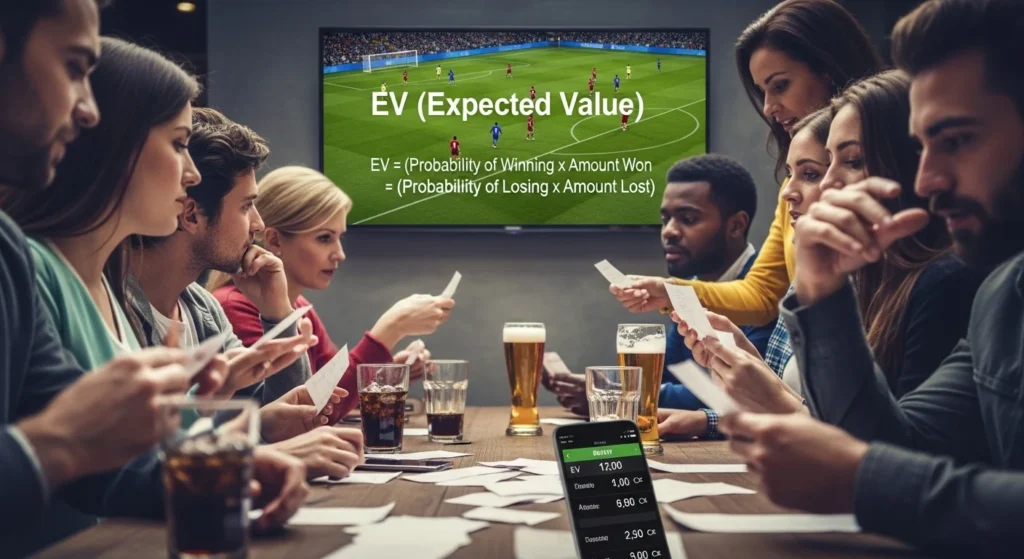

EV in betting stands for Expected Value. It is a mathematical calculation used to estimate how much profit or loss a bet is expected to generate over time.
In sports betting, some bettors rely on luck, while others rely on math. If you have ever explored advanced betting strategies or read expert betting guides, you have probably come across the term EV. Many beginners ask the same question: what does EV mean in betting, and why do serious bettors care so much about it?
EV is one of the most important concepts in betting because it focuses on long term profit rather than short term wins. Understanding EV can completely change how you place bets, evaluate odds, and think about risk. In this article, we will explain EV in simple language, show real examples, compare it with similar terms, and help you understand how it is used in real world betting.
Origin of EV and Why It Matters

The concept of Expected Value comes from probability theory and statistics. It has been used for decades in mathematics, economics, insurance, and gambling. Casinos, sportsbooks, and professional bettors all rely on EV calculations to manage risk and predict outcomes.
EV became popular in sports betting as online sportsbooks grew and bettors gained access to detailed odds, probabilities, and data. Sharp bettors realized that beating the sportsbook is not about predicting winners perfectly but about finding bets where the odds are better than they should be.
This idea made EV one of the core foundations of professional betting strategies.
How EV Works in Betting
To understand EV, you need to understand probability and odds. EV combines both to show whether a bet offers value.
The basic idea is this. If the probability of an outcome happening is higher than what the odds suggest, the bet has positive EV. If the probability is lower than what the odds suggest, the bet has negative EV.
Even if you lose a positive EV bet today, it can still be a good bet because over many similar bets, the math works in your favor.
Simple EV Formula Explained
The basic EV formula in betting is:
Expected Value equals probability of winning multiplied by profit minus probability of losing multiplied by stake.
You do not need to be a math expert to understand the logic. EV compares what you expect to win versus what you expect to lose.
If the final number is positive, the bet has value. If it is negative, the bet is not worth taking in the long run.
Real World EV Examples With Context
Understanding EV becomes much easier when you see examples.
Friendly and Educational Example
Imagine you bet 100 units on a team with odds of 2.00. You believe the team has a 60 percent chance of winning.
If the team wins, you profit 100 units. If it loses, you lose 100 units.
Your EV would be positive because your estimated probability is higher than what the odds imply. This means it is a good bet long term, even if you lose today.
Neutral Example
You place a bet with odds that perfectly match the true probability of an outcome. Over time, you would neither win nor lose money on average. This is called zero EV.
Negative or Dismissive Example
You bet on a heavy favorite with very low odds that do not reflect the true risk. Even though the team wins often, the payout is too small. Over time, this creates negative EV and slowly drains your bankroll.
This is why many casual bettors lose money even when they win frequently.
Labeled Example Table for EV in Betting
Bet Type | Odds | Estimated Probability | EV Result | Meaning
Single Match Bet | 2.50 | 45 percent | Positive EV | Profitable long term
Heavy Favorite | 1.20 | 75 percent | Negative EV | Risk outweighs reward
Fair Odds Bet | 2.00 | 50 percent | Zero EV | Break even over time
Underdog Bet | 4.00 | 30 percent | Positive EV | High value opportunity
This table shows how EV depends on probability, not just odds.
Popularity of EV Among Bettors
EV is extremely popular among professional bettors, traders, and sharp gamblers. It is commonly discussed in sports betting forums, analytics blogs, and advanced betting tools.
Casual bettors may not calculate EV directly, but sportsbooks always do. This is why sportsbooks adjust odds quickly when sharp money enters the market.
Understanding EV helps bettors think like professionals instead of gamblers.
EV vs Similar Betting Terms
EV is often confused with other betting concepts. Here is how it compares.
ROI vs EV
EV measures expected profit per bet, while ROI measures actual profit over time. EV is predictive, ROI is historical.
Probability vs EV
Probability estimates how likely something is to happen. EV uses probability to determine whether a bet is profitable.
Value Betting vs EV
Value betting is the strategy of placing positive EV bets. EV is the calculation behind value betting.
EV vs House Edge
House edge represents the sportsbook advantage. Positive EV bets are attempts to overcome or reduce that edge.
Alternate Meanings of EV
While EV in betting almost always means Expected Value, the abbreviation EV can have other meanings in different fields.
In finance, EV can mean Enterprise Value.
And in automobiles, EV refers to Electric Vehicles.
In gaming, EV may sometimes mean Event Value.
In betting contexts, however, EV nearly always refers to Expected Value.
Professional and Polite Alternatives to EV
In professional writing or beginner guides, EV may be replaced with clearer terms such as expected profit, long term value, or mathematical advantage.
These alternatives help new bettors understand the idea without technical language.
FAQs
What does EV mean in betting?
EV in betting means Expected Value, which measures how much profit or loss a bet is expected to produce over time based on probability and odds.
Is EV guaranteed profit?
No, EV does not guarantee short term wins. It only predicts long term results if similar bets are placed repeatedly.
Can you win with negative EV bets?
You can win individual bets, but negative EV bets usually lead to losses over time.
Why do sportsbooks care about EV?
Sportsbooks use EV to set odds that protect their profit and manage risk across many bettors.
Do professional bettors only place EV bets?
Most professional bettors focus almost exclusively on positive EV bets because they aim for consistent long term profit.
Is EV important for beginners?
Yes, understanding EV helps beginners avoid bad bets and build smarter betting habits early.
Can EV be wrong?
EV depends on accurate probability estimates. If your probabilities are wrong, the EV calculation will also be wrong.
Is EV used in casino games?
Yes, EV is used in casino games to calculate house edge and expected player losses.
Conclusion
Positive EV bets focus on value rather than emotion, meaning successful bettors make decisions based on mathematics and probability instead of gut feelings or favorite teams.
Short term losses do not mean a bet was bad, because even the best value bets can lose occasionally due to natural variance in sports outcomes. Long term thinking separates professional bettors from casual gamblers, as professionals judge success by overall performance across many bets rather than single results.
Accurate probability estimation is the key to correct EV, because the better you assess true chances compared to bookmaker odds, the stronger your betting decisions become over time.
See Also More:
- What Does Duplex Mean in Printing Complete Beginner Guide 2026
- What Does Semi Conservative Mean in DNA Replication? Explained 2026