
In today’s fast moving business world, companies rely heavily on abbreviations and strategic frameworks to communicate ideas quickly and effectively. One such term that frequently appears in boardroom discussions, startup pitches, marketing meetings, and business articles is GTM. If you have ever paused and asked yourself, what does GTM mean in business, you are not alone. This article will clearly explain the meaning of GTM, its origins, popularity, real world usage, examples, comparisons with related concepts, and much more in a simple and professional way.
Definition
GTM in business stands for Go To Market. It refers to a strategic plan that outlines how a company will introduce a product or service to the market, identify its target customers, communicate value, and generate revenue. In essence, a GTM strategy defines the path a business takes to reach customers and succeed commercially.
Origin of GTM
The concept of Go To Market did not emerge suddenly. It evolved as businesses realized that having a great product alone was not enough to succeed.
Early Business Practices
In traditional industries, companies relied heavily on sales teams and physical distribution networks. Marketing and sales decisions were often separate and reactive rather than strategic.
Rise of Technology and Startups
The term GTM gained strong popularity during the growth of technology companies and startups. Software products, especially SaaS platforms, required structured launch plans to compete in crowded markets.
Modern Usage
Today, GTM is a standard business term used across industries such as technology, healthcare, finance, ecommerce, and manufacturing. As markets became more competitive, companies adopted GTM strategies to reduce risk and improve execution.
The growing use of GTM reflects the need for alignment between product, marketing, sales, and customer success teams.
Popularity of GTM in Business Communication
The popularity of GTM has increased significantly over the past decade due to its practical value.
Startups and Entrepreneurs
Founders use GTM strategies to validate ideas, attract early customers, and secure investment by showing a clear plan for market entry.
Corporate and Enterprise Settings
Large organizations rely on GTM frameworks to ensure consistent product launches across regions and departments.
Marketing and Sales Teams
Marketing and sales professionals frequently reference GTM to align messaging, pricing, and distribution channels.
This widespread adoption makes GTM one of the most commonly discussed concepts in modern business strategy.
How GTM Is Used in Business With Examples
To fully understand what does GTM mean in business, it helps to see how it is used in real conversations and scenarios.
| Context | GTM Meaning | Example | Tone |
|---|---|---|---|
| Startup meeting | Go To Market strategy | We need a clear GTM before pitching to investors | Strategic and serious |
| Corporate planning | Market entry approach | The GTM for our new product targets mid size firms | Professional |
| Marketing discussion | Launch execution plan | Our GTM focuses on digital channels first | Neutral |
| Post launch review | Success or failure analysis | The GTM failed due to weak positioning | Critical |
Usage Tips
Always define GTM clearly when speaking to non technical audiences.
Use GTM consistently across departments to avoid confusion.
Avoid vague GTM plans that lack customer focus or clear metrics.
Key Elements of a GTM Strategy
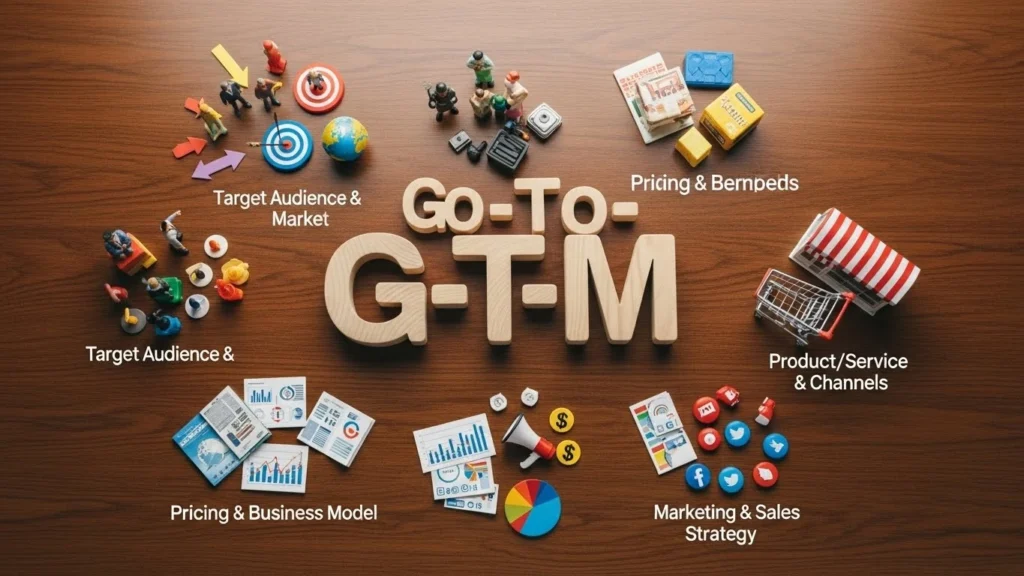
A strong Go To Market strategy typically includes several essential components.
Target Market
This defines who the product is for, including industry, company size, and buyer persona.
Value Proposition
This explains why customers should choose your product over competitors.
Pricing and Packaging
Pricing models such as subscription, freemium, or one time purchase are defined here.
Sales and Distribution Channels
This covers how customers will buy the product, whether through direct sales, partners, or online platforms.
Marketing Channels
Marketing channels may include content marketing, paid advertising, social media, or events.
Customer Support and Retention
Post sale experience is critical to long term success and customer loyalty.
Comparison With Similar Business Terms
GTM is often confused with other strategic concepts. Understanding the differences helps clarify its role.
| Term | Meaning | How It Differs From GTM |
|---|---|---|
| Marketing Strategy | Focuses on promotion | GTM includes sales and distribution |
| Sales Strategy | Focuses on closing deals | GTM starts before sales begin |
| Product Strategy | Defines what to build | GTM defines how to sell it |
| Business Strategy | Long term vision | GTM is execution focused |
This comparison highlights that GTM is broader and more execution oriented than many related terms.
Alternate Meanings of GTM
While GTM most commonly means Go To Market in business, it can have other meanings in specific contexts.
In digital marketing discussions, GTM may refer to Google Tag Manager.
In logistics or trade discussions, it can occasionally mean Global Trade Management.
Despite these alternate meanings, Go To Market remains the dominant interpretation in business strategy conversations.
Polite and Professional Alternatives to GTM
In formal writing or presentations, spelling out GTM can improve clarity.
Go To Market strategy
Market entry strategy
Product launch plan
Commercialization strategy
Using full terms is especially helpful when communicating with clients or stakeholders unfamiliar with business jargon.
Common GTM Mistakes Businesses Make
Even experienced companies can struggle with GTM execution.
Targeting an audience that is too broad
Weak or unclear value proposition
Misalignment between marketing and sales
Poor pricing decisions
Ignoring customer feedback after launch
Avoiding these mistakes can significantly increase the chances of a successful market entry.
Conclusion
Understanding what does GTM mean in business is essential for anyone involved in launching or growing a product. GTM, or Go To Market, is not just a buzzword. It is a structured approach that connects strategy with execution.
A strong GTM strategy helps businesses reach the right customers, communicate value clearly, and generate sustainable revenue. Whether you are a startup founder, marketer, or business leader, mastering GTM principles can greatly improve decision making and outcomes.
By focusing on customers, aligning teams, and continuously refining your approach, GTM becomes a powerful tool for long term success.
FAQs
What does GTM mean in business?
GTM in business means Go To Market. It refers to the strategic plan a company uses to launch a product or service, identify target customers, choose sales channels, and drive revenue effectively.
Why is a GTM strategy important?
A GTM strategy is important because it reduces risk, aligns teams, and ensures that a product addresses real customer needs while reaching the market efficiently.
Is GTM only used by startups?
No, GTM is used by startups, small businesses, and large enterprises alike. Any organization introducing a new product or entering a new market can benefit from a GTM strategy.
What are the main components of a GTM strategy?
The main components include target market definition, value proposition, pricing, sales channels, marketing plan, and customer support strategy.
How is GTM different from a marketing strategy?
A marketing strategy focuses primarily on promotion, while GTM is broader and includes sales, pricing, distribution, and customer onboarding.
Can a GTM strategy change over time?
Yes, GTM strategies should evolve as markets, customer behavior, and competition change. Continuous improvement is key to long term success.
What happens if a company skips GTM planning?
Skipping GTM planning often leads to poor adoption, wasted resources, unclear messaging, and lower revenue performance.
How do you measure GTM success?
GTM success is measured using metrics such as customer acquisition cost, conversion rates, revenue growth, retention rates, and market penetration.
See Also More :
- What Does NTP Mean in Spanish? Definition, Usage And Examples 2026
- What Does -1 Mean in Football Betting? Definition, Examples & Smart Betting Tips