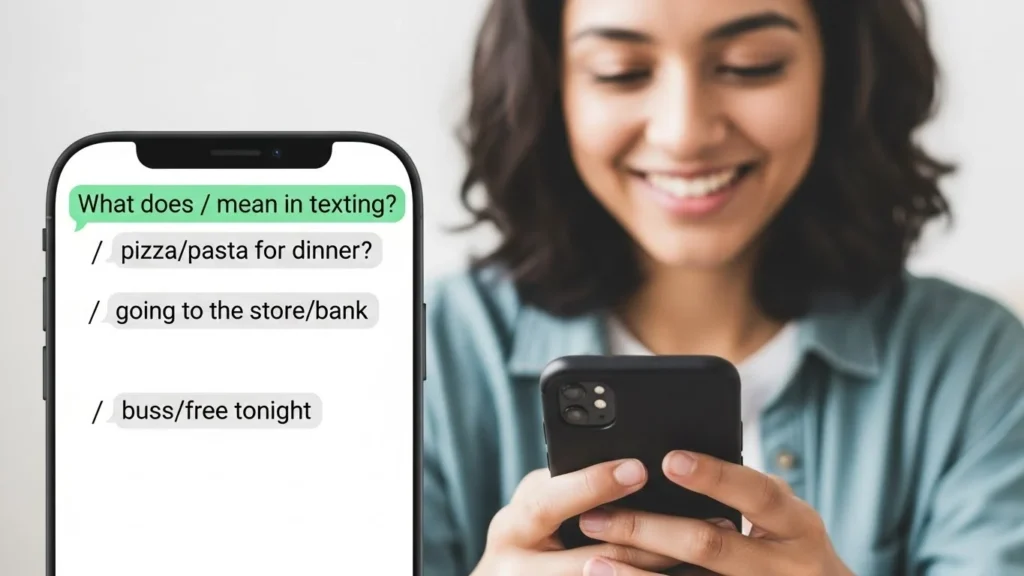

You’ve probably seen messages like “yes/no,” “ok/whatever,” or “I’m tired/sleepy” and paused for a second. That tiny slash might look harmless, but in texting, it can subtly shift tone, intent, and meaning.
In modern digital communication especially texting, social media, gaming chats, and workplace messaging the slash ( / ) has evolved far beyond its grammatical roots. It now carries emotional cues, conversational shortcuts, and even passive-aggressive undertones in some contexts.
This article breaks down what “/” means in texting, how people actually use it in real conversations, how tone changes based on context, and when you should (or shouldn’t) use it. By the end, you’ll know exactly how to read and write messages with slashes confidently.
Definition
In texting and online messaging, “/” (slash) is commonly used to separate ideas, show alternatives, clarify tone, or add context. It often acts as a shorthand replacement for words like “or,” “and,” “per,” or “instead of.” Depending on how it’s used, the slash can feel casual, neutral, humorous, or even slightly dismissive.
What Is “/” in Texting?
In texting, “/” is a multifunctional separator that can mean:
- Or → yes/no
- And → work/home life
- Combined or overlapping ideas → tired/exhausted
- Tone softener or casual shorthand → sure/okay
- Correction or clarification → Tuesday/actually Wednesday
- Light sarcasm or indifference → fine/whatever
The meaning depends heavily on context, relationship, and tone.
Origin and Evolution of the Slash in Digital Communication
Traditional Use
Historically, the slash (also called a virgule) was used in writing to:
- Separate poetic lines
- Indicate alternatives
- Represent “per” (miles/hour)
Digital Shift
With the rise of:
- SMS texting
- Online forums
- Chat apps (WhatsApp, Messenger, Discord)
- Social media captions
People needed faster, shorter ways to express complex ideas. The slash became popular because it:
- Saves space
- Feels casual
- Mimics spoken hesitation or blending of thoughts
Over time, it gained emotional meaning, not just grammatical function.
How “/” Is Commonly Used in Texting
1. To Show Alternatives (Most Common Use)
This is the clearest and most neutral usage.
Examples:
- yes/no
- today/tomorrow
- coffee/tea
Meaning: One option or the other.
2. To Combine Similar Feelings or States
People often use “/” to stack emotions or descriptions.
Examples:
- tired/sleepy
- happy/excited
- nervous/anxious
Meaning: Both feelings apply or overlap.
3. To Replace “And” Casually
This usage feels relaxed and conversational.
Examples:
- work/home balance
- family/friends time
- school/life stress
Meaning: Both things together.
4. To Add Clarification or Self-Correction
The slash can work like a quick edit.
Examples:
- See you Friday/Saturday
- That was fun/weird
- He said no/hesitated
Meaning: Refining or adjusting the statement.
5. To Express Indifference or Soft Dismissal
This is where tone becomes important.
Examples:
- ok/whatever
- sure/fine
- yeah/alright
Meaning: Mild disinterest, resignation, or emotional distance.
Tone Matters: How “/” Changes Emotional Meaning
The slash itself is neutral—but context decides tone.
Friendly Tone
- Excited/nervous for tomorrow 😅
- Pizza/burgers tonight?
Feels relaxed and informal.
Neutral Tone
- Available Monday/Tuesday
- Choose yes/no
Straightforward and practical.
Dismissive or Passive-Aggressive Tone
- ok/whatever
- sure/if you say so
Often signals annoyance or lack of enthusiasm.
Labeled Example Table: Slash Usage & Meaning
| Text Example | Context | Implied Meaning | Tone |
|---|---|---|---|
| yes/no | Question | Choose one option | Neutral |
| tired/exhausted | Status update | Very tired | Friendly |
| ok/fine | Argument | Reluctant agreement | Dismissive |
| work/home | Lifestyle | Both areas | Neutral |
| sure/whatever | Disagreement | Mild annoyance | Negative |
| excited/nervous 😅 | Event | Mixed emotions | Friendly |
Real-World Usage: Where You’ll See “/” Most
- Text messages (casual chats)
- Social media captions
- Online forums
- Gaming chats
- Workplace messaging apps (Slack, Teams—used carefully)
In professional settings, it’s usually best kept neutral and minimal.
Comparison: “/” vs Similar Texting Symbols
Slash ( / ) vs “or”
- Slash: Faster, informal (yes/no)
- Or: Clearer, formal (yes or no)
Slash ( / ) vs Comma (, )
- Slash: Suggests choice or overlap (happy/excited)
- Comma: Lists items (happy, excited)
Slash ( / ) vs Dash ( – )
- Slash: Alternatives or blending
- Dash: Explanation or pause
Alternate Meanings of “/”
Although texting is the focus, the slash can also mean:
- Per: miles/hour
- Web paths: /about/contact
- Commands: /mute, /help (gaming or apps)
- Dates: 10/12/2026
Context makes the meaning obvious.
Polite and Professional Alternatives to Using “/”
If you’re unsure about tone—especially at work—use these instead:
- Replace yes/no → Please confirm your preference
- Replace ok/whatever → Understood
- Replace Monday/Tuesday → Either Monday or Tuesday
Clear language avoids misinterpretation.
When Should You Avoid Using “/” in Texting?
Avoid or limit slashes when:
- Writing formal emails
- Communicating with clients
- Discussing sensitive topics
- You want to sound warm and engaged
Slashes can feel cold or rushed if overused.
Practical Tips for Using “/” Correctly
- Use it for quick clarity, not emotional conversations
- Avoid stacking too many slashes in one message
- Add emojis if tone might be misunderstood
- Consider your relationship with the reader
Conclusion:
The slash ( / ) in texting is a powerful little symbol. It helps people communicate faster, combine ideas, show alternatives, and express mixed emotions all in one keystroke. But with that efficiency comes responsibility: tone matters.
Used thoughtfully, “/” keeps messages casual and clear. Used carelessly, it can sound dismissive or cold. Understanding its meaning and when to replace it with clearer words will instantly improve how your messages are read and received.
FAQs
1. What does “/” mean in texting slang?
In texting slang, “/” usually separates ideas, shows alternatives, or combines similar thoughts. It often replaces words like “or” or “and” to keep messages short and casual.
2. Is using “/” in texting rude?
It’s not inherently rude, but it can sound dismissive depending on context. Phrases like ok/whatever may feel passive-aggressive, while yes/no is neutral.
3. What does “ok/whatever” mean in a text?
This phrase often suggests indifference, frustration, or reluctant agreement. Tone depends on the conversation and relationship between the people texting.
4. Is “/” professional to use in work messages?
In limited cases, yes such as Monday/Tuesday availability. However, full words are safer in formal or client-facing communication.
5. What does tired/exhausted mean in texting?
It usually means the person feels very tired, using two similar words to emphasize their state.
6. Can “/” replace “or” in all cases?
No. While it works in casual texting, full sentences with “or” are clearer in formal writing or sensitive discussions.
7. Why do people use “/” instead of punctuation?
People use it for speed, tone, and conversational flow. It mimics spoken language and saves time.
8. Does “/” always mean a choice?
Not always. It can mean choice, combination, clarification, or emotional overlap depending on how it’s used.
See Also More :
- What Does COB Mean in Insurance? Definition and Complete Guide
- What Does VR Mean in Email? Definition, Usage, and Complete Guide