
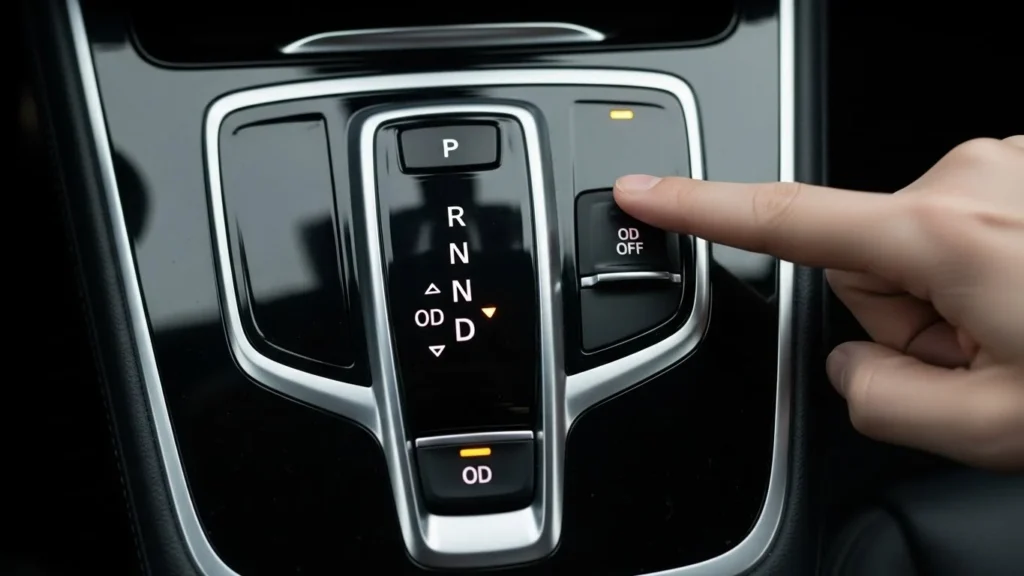

If you’ve ever been driving and noticed a light on your dashboard that says “OD OFF”, it can be confusing—especially if you didn’t press anything or don’t know what it does. Many drivers assume something is wrong with the car, but in most cases, OD OFF is completely normal and intentional.
In this detailed, easy-to-understand guide, we’ll explain what OD OFF means in a car, why it exists, when to use it, real-world driving examples, comparisons with related terms, common mistakes, FAQs, and practical tips—all in a friendly but professional tone.
Definition
OD OFF in a car means “Overdrive Off.”
It indicates that the vehicle’s overdrive gear is disabled, preventing the transmission from shifting into its highest gear to provide more engine power and better control.
Understanding Overdrive in Simple Terms
To understand OD OFF, you first need to understand overdrive (OD).
What Is Overdrive?
Overdrive is the highest gear in an automatic transmission. It allows the engine to run at lower RPMs while maintaining speed, which helps:
- Improve fuel efficiency
- Reduce engine wear
- Provide smoother highway driving
When overdrive is turned off, the transmission will not shift into its highest gear.
What Happens When OD Is Turned Off?
When the OD OFF light is on:
- The transmission stays in lower gears
- Engine RPM stays higher
- The car produces more torque
- Fuel consumption increases slightly
This is not a malfunction—it’s a driving mode choice.
Why Cars Have an OD OFF Feature
Overdrive is great for steady speeds, but it’s not ideal for every situation. The OD OFF feature exists to give drivers better control and power when needed.
Main Reasons for Using OD OFF
- Climbing steep hills
- Towing heavy loads
- Driving in stop-and-go traffic
- Descending hills (engine braking)
- Preventing constant gear shifting
Origin and History of Overdrive
Overdrive technology became common in automatic transmissions during the late 20th century as manufacturers focused on fuel efficiency.
As vehicles became more powerful, drivers needed a way to disable overdrive when extra torque or control was required, leading to the OD OFF function.
Where You’ll See the OD OFF Indicator
The OD OFF indicator usually appears:
- On the dashboard
- Near the gear shifter
- As a button on the shift lever or center console
In some vehicles, OD OFF activates automatically based on driving conditions.
Real-World Driving Examples
Example 1: Highway Driving (OD ON)
You’re cruising at 65 mph on a flat highway.
- Overdrive engaged
- Lower RPM
- Better fuel efficiency
Example 2: Towing a Trailer (OD OFF)
You’re towing a camper uphill.
- OD OFF prevents gear hunting
- Engine stays in a stronger gear
- Improved control and power
Example 3: City Traffic (OD OFF)
Frequent stops and starts can cause constant shifting.
- OD OFF keeps gears stable
- Smoother driving experience
Tone and Meaning of OD OFF
The OD OFF light has a neutral and informational tone.
It does not indicate:
- Engine failure
- Transmission damage
- Mechanical error
However, if the light is flashing or won’t turn off, that may indicate a problem.
OD OFF vs Related Driving Terms
OD OFF vs Drive (D)
- Drive includes all gears, including overdrive
- OD OFF limits the highest gear
OD OFF vs Manual Mode
- Manual mode lets you select gears manually
- OD OFF only disables overdrive
OD OFF vs Low Gear (L)
- Low gear is for maximum torque at low speeds
- OD OFF is for moderate control at normal speeds
When You Should Use OD OFF
Recommended situations:
- Towing or hauling heavy loads
- Mountain or hilly terrain
- Long downhill descents
- Stop-and-go city driving
When You Should NOT Use OD OFF
Avoid using OD OFF:
- On flat highways at steady speeds
- For long-distance cruising
- When fuel efficiency is a priority
Common Mistakes Drivers Make
- Thinking OD OFF means something is broken
- Driving long distances with OD OFF unnecessarily
- Ignoring a flashing OD OFF light
- Confusing OD OFF with transmission failure
Fuel Efficiency Impact
| Mode | Fuel Economy | Engine RPM |
|---|---|---|
| OD ON | Higher | Lower |
| OD OFF | Lower | Higher |
OD OFF trades fuel efficiency for power and control.
Conclusion
Understanding what OD OFF means in a car helps you drive more confidently and protect your vehicle. It’s not a warning sign
it’s a tool designed to give you better control when driving conditions demand it.
By using OD OFF correctly, you can improve performance, reduce transmission stress, and enjoy a smoother driving experience.
Frequently Asked Questions
What does OD OFF mean on my dashboard?
It means overdrive is disabled and the car will not use its highest gear.
Is it bad to drive with OD OFF on?
No, but it may reduce fuel efficiency if used unnecessarily.
Should I use OD OFF when towing?
Yes, it helps prevent transmission strain.
Can OD OFF damage the transmission?
No, it is a built-in feature designed for specific conditions.
Why does my OD OFF light turn on by itself?
Some vehicles activate it automatically based on load or driving conditions.
Does OD OFF help in snow or rain?
It can improve control by limiting gear changes.
Is OD OFF the same as sport mode?
No, sport mode adjusts multiple performance settings.
What should I do if OD OFF is flashing?
Have the transmission checked—it may indicate a fault.