

Quick Answer:
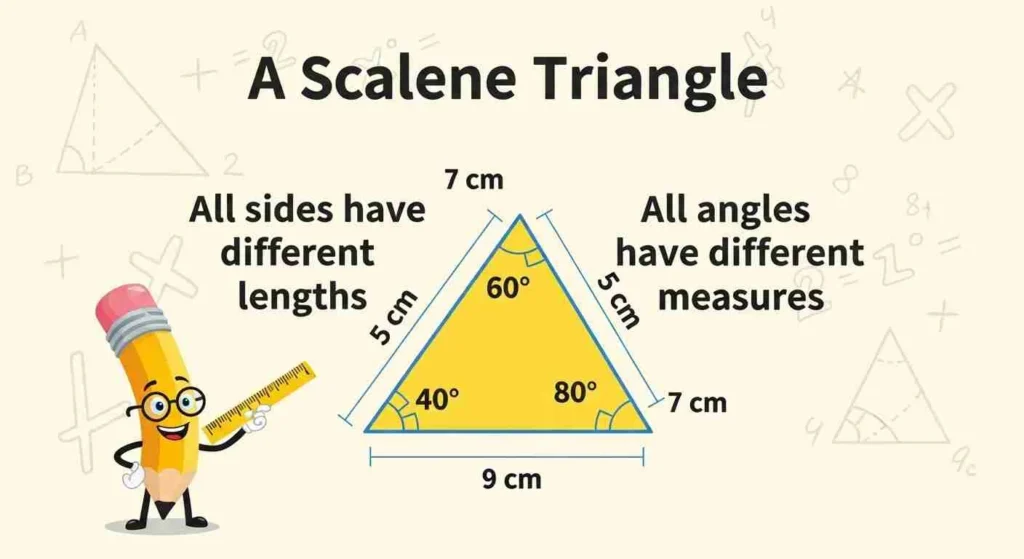
In mathematics, a scalene triangle is a triangle in which all three sides have different lengths and all three interior angles are different.
In geometry, understanding triangle types is essential because they form the foundation of many mathematical concepts. Among the three main triangle categories, the scalene triangle is often the most misunderstood. Students frequently confuse it with isosceles or equilateral triangles, yet it has its own distinct identity and rules.
This comprehensive guide explains what scalene means in math, its origin, real world usage, properties, examples, comparisons with other triangle types, and frequently asked questions. By the end, you will have a clear and confident understanding of scalene triangles and how they work in geometry.

4
Understanding the Meaning of Scalene in Math
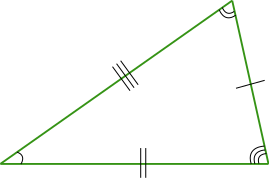
In mathematics, the word scalene specifically refers to a type of triangle. A scalene triangle is defined by the fact that no two sides are equal in length. Because all sides are different, each interior angle is also different.
This makes scalene triangles unique compared to other triangle types that have equal sides or angles. The unequal structure affects calculations related to perimeter, area, and angle measures.
Key characteristics of a scalene triangle include
- All sides have different lengths
- All interior angles have different measures
- No lines of symmetry exist
- No equal sides or equal angles
These features make scalene triangles highly flexible in geometric applications.
Origin and Historical Background of the Term Scalene
The term scalene has roots in ancient Greek mathematics. It comes from the Greek word skalenos, which means unequal or uneven. Early mathematicians used this term to classify triangles that did not have equal sides.
Greek geometers such as Euclid studied triangle classification as part of foundational geometry. They categorized triangles into three main types based on side lengths
- Equilateral triangles with three equal sides
- Isosceles triangles with two equal sides
- Scalene triangles with all sides unequal
This classification system remains in use today in schools, engineering, architecture, and higher mathematics.
Why Scalene Triangles Are Important in Real World Math
Scalene triangles are not just theoretical concepts. They appear frequently in real world structures and measurements. Because they do not require symmetry or equal lengths, they are common in natural and practical designs.
Some real world uses include
- Surveying land measurements where sides differ
- Architectural designs with irregular shapes
- Bridge supports and truss systems
- Computer graphics and 3D modeling
- Physics problems involving forces and vectors
In these fields, scalene triangles help represent realistic and non symmetrical forms that equilateral or isosceles triangles cannot model accurately.
Key Properties of a Scalene Triangle
To fully understand what scalene means in math, it is important to explore its defining properties.
Unequal Side Lengths
The primary property is that all three sides are different. For example, a triangle with sides 4 cm, 5 cm, and 7 cm is scalene.
Unequal Angles
Since side lengths differ, the interior angles must also differ. The largest angle is always opposite the longest side.
No Line of Symmetry
Unlike isosceles or equilateral triangles, a scalene triangle has no line that divides it into two identical halves.
Angle Sum Rule
Even though the sides and angles differ, the total of all interior angles still equals 180 degrees, just like every triangle.
Example Table Showing Scalene Triangle Properties
| Property | Description | Example |
|---|---|---|
| Side Lengths | All three sides are different | 3 cm, 5 cm, 8 cm |
| Angle Measures | All angles are unequal | 40°, 60°, 80° |
| Symmetry | No symmetry line | Irregular shape |
| Angle Sum | Always equals 180° | 40 + 60 + 80 = 180 |
This table shows that while scalene triangles lack equality among sides and angles, they still follow universal triangle rules.
How Scalene Is Used in Math Problems and Geometry
In mathematics, scalene triangles are used in various types of problems. Students encounter them in geometry lessons, trigonometry calculations, and real world measurement exercises.
Example in a classroom setting
A teacher may ask students to find the area of a scalene triangle using Heron’s formula because traditional base height methods may not always be straightforward.
Example in real life measurement
An engineer measuring irregular land boundaries may form scalene triangles to calculate area accurately.
Tone explanation
Neutral and academic, as the term is purely mathematical and objective.
Comparing Scalene with Other Triangle Types
Understanding scalene becomes easier when compared with other triangle classifications.
| Triangle Type | Side Lengths | Angle Relationship | Symmetry |
|---|---|---|---|
| Equilateral | All equal | All angles equal | Three lines |
| Isosceles | Two equal | Two angles equal | One line |
| Scalene | All different | All angles different | None |
This comparison shows that scalene triangles are the most irregular type, while equilateral triangles are perfectly symmetrical.
Usage Tips for Identifying a Scalene Triangle
Students often struggle to quickly identify triangle types. These simple tips help determine whether a triangle is scalene.
- Check if all three sides have different lengths
- Confirm that no angles are equal
- Observe that the triangle has no mirror symmetry
- Remember that unequal sides automatically mean unequal angles
If all these conditions are met, the triangle is scalene.
Mathematical Formulas Related to Scalene Triangles
Although scalene triangles are irregular, standard triangle formulas still apply.
Perimeter formula
Add all three side lengths together
Area formula using Heron’s method
Area equals square root of s multiplied by s minus a multiplied by s minus b multiplied by s minus c
Where s is half the perimeter
These formulas allow accurate measurement even when no sides are equal.
Alternate Meanings of Scalene Outside Math
The term scalene is almost always used in geometry. However, in rare contexts, it may describe something uneven or asymmetrical in a figurative sense. Still, its primary and accepted meaning belongs to mathematics and triangle classification.
Professional and Academic Alternatives for Clarity
In formal academic writing, teachers may use clearer descriptive phrases alongside the term scalene.
Examples include
- Triangle with unequal sides
- Irregular triangle with three different sides
- Non symmetrical triangle
These alternatives help beginners grasp the concept before fully adopting the mathematical term scalene.
Common Mistakes Students Make About Scalene Triangles
Students frequently misunderstand scalene triangles due to confusion with isosceles and equilateral types.
Typical mistakes include
- Assuming unequal angles can still have equal sides
- Forgetting that scalene triangles have zero symmetry lines
- Thinking any irregular triangle is scalene without checking side lengths
Correct identification requires confirming that all three sides differ.
FAQs
What does scalene mean in math?
Scalene in math refers to a triangle where all three sides and all three angles are different, making it an uneven and non symmetrical triangle.
How is a scalene triangle different from an isosceles triangle?
A scalene triangle has no equal sides, while an isosceles triangle has two equal sides and two equal angles.
Can a scalene triangle have a right angle?
Yes, a triangle can be both scalene and right angled if all three sides are different and one angle measures 90 degrees.
Why are scalene triangles important in geometry?
They help represent irregular shapes and are used in advanced calculations such as trigonometry, surveying, and engineering measurements.
Do scalene triangles have equal angles?
No, since all sides are unequal, each interior angle is also different.
Is every irregular triangle scalene?
Not always, because some irregular triangles may still have two equal sides, making them isosceles rather than scalene.
How do you identify a scalene triangle quickly?
Measure all three sides and confirm they are different, then check that all angles are also different.
Can scalene triangles exist in real life structures?
Yes, they commonly appear in bridges, buildings, and land measurements where equal sides are not required.
Conclusion
Understanding what scalene means in math is essential for mastering basic geometry and real world measurement concepts. A scalene triangle is defined by its unequal side lengths and unequal angles, which give it a unique irregular shape. Unlike equilateral and isosceles triangles, it has no symmetry and offers flexibility for representing realistic structures and complex calculations.
Students should remember that identifying a scalene triangle simply requires checking that all sides are different. This concept forms a strong foundation for advanced geometry, trigonometry, engineering design, and spatial reasoning. By recognizing its properties, formulas, and comparisons with other triangle types, learners can confidently solve problems involving scalene triangles in both academic and real world contexts.
See Also More :
- What Does 999 Mean in Love Spiritual and Emotional Meaning Explained for 2026
- What Does Wallah Mean in Arabic Full Meaning and Usage Explained for 2026