
Quick Answer:
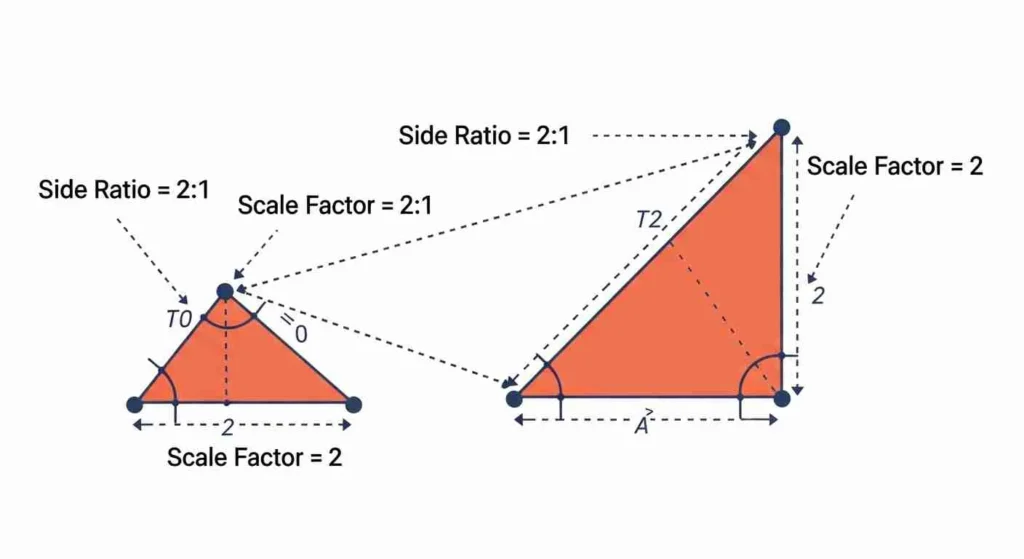
In math, similar means that two shapes or figures have the same shape but not necessarily the same size. Their corresponding angles are equal, and their corresponding sides are proportional.
Mathematics uses precise language, and the word similar has a very specific meaning when applied to shapes, figures, and geometric objects. Students often assume similar simply means almost the same, but in math it has a deeper and more technical definition. Understanding similarity is essential in geometry, algebra, trigonometry, and real world problem solving involving scale drawings, maps, and models.
This complete guide explains what similar means in math, its origin and concept development, how it is used in real mathematical contexts, examples with explanations, comparisons with related terms, alternate meanings, and FAQs with clear answers to common student questions.
Understanding the Meaning of Similar in Math
In mathematics, two figures are called similar if they have the same shape but may differ in size. This means:
- Corresponding angles are equal
- Corresponding side lengths are in proportion
- The figures can be enlarged or reduced versions of each other
For example, two triangles of different sizes can still be similar if their angles match and their sides follow the same ratio.
Similarity focuses on shape consistency, not exact size.
Origin and Concept Development of Similarity in Mathematics
The idea of similarity dates back to ancient Greek mathematics, particularly the work of Euclid. Early geometers observed that shapes could be scaled up or down while preserving their form. This concept became fundamental in geometry and later influenced architecture, engineering, and art.
Similarity allowed mathematicians to compare figures, calculate unknown lengths, and solve complex spatial problems using proportional reasoning. Over time, the concept evolved into formal theorems and rules taught in modern geometry classes.
Today, similarity is widely used in:
- Geometry proofs
- Scale drawings and blueprints
- Map reading and navigation
- Engineering design
- Computer graphics and modeling
Real World Usage of Similar Figures
The concept of similar figures is not limited to textbooks. It plays an important role in everyday life.
Examples include:
- Architectural models that are scaled versions of real buildings
- Maps that represent large areas in smaller sizes
- Photographs resized while keeping proportions intact
- Engineering prototypes designed before final construction
These real world applications show that similarity helps maintain accuracy while adjusting size.
Key Properties of Similar Figures
For two shapes to be mathematically similar, they must satisfy specific conditions.
Equal Corresponding Angles
Every angle in one figure must match the corresponding angle in the other figure.
Proportional Corresponding Sides
The ratios of matching sides must remain constant. If one side doubles, all corresponding sides must double as well.
Same Shape, Different Size
Similar figures can be larger or smaller versions of each other, but their overall form stays consistent.
Visual Understanding of Similar Shapes

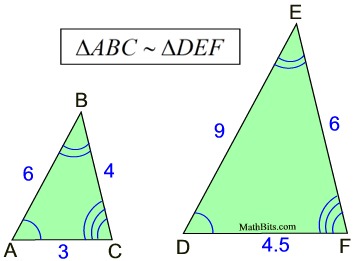

6
These visuals show how figures maintain the same shape while changing in size, demonstrating the idea of proportional scaling.
Types of Similar Figures in Geometry
Similar Triangles
Triangles are similar when their corresponding angles are equal and sides are proportional.
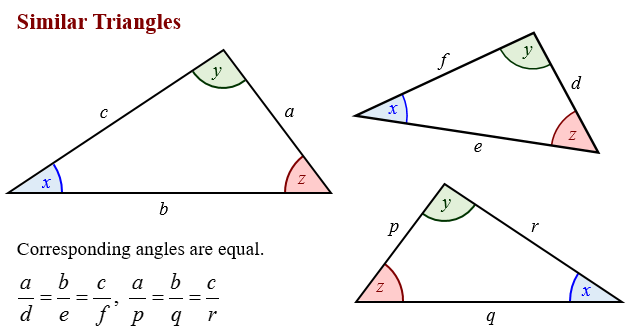
6
Common similarity rules for triangles include:
- AA similarity where two angles are equal
- SAS similarity involving side ratio and included angle
- SSS similarity where all three sides are proportional
Similar Polygons
Polygons are similar if all corresponding angles are equal and side ratios match consistently.
Example Table Showing Similar Figures
| Figure A | Figure B | Are They Similar | Reason |
|---|---|---|---|
| Triangle with sides 3, 4, 5 | Triangle with sides 6, 8, 10 | Yes | Sides are proportional |
| Square 2 cm each side | Square 5 cm each side | Yes | Same shape, scaled size |
| Rectangle 2 by 4 | Rectangle 3 by 5 | No | Ratios not equal |
| Circle radius 3 | Circle radius 6 | Yes | Radius doubled proportionally |
This table highlights how proportional relationships determine similarity.
Tone Explanation When Using the Term Similar in Math Context
Unlike casual language, similar in math has a precise and neutral tone. It is not emotional or subjective.
Friendly explanation tone
These two triangles are similar because their angles match perfectly
Neutral academic tone
The polygons are similar due to equal corresponding angles and proportional sides
Incorrect dismissive tone
They look alike so they must be similar
This last statement is incorrect mathematically because visual appearance alone does not confirm similarity without proportional measurements.
Comparison With Related Mathematical Terms
Understanding similar becomes easier when compared with related geometry terms.
| Term | Meaning | Difference From Similar |
|---|---|---|
| Congruent | Same shape and same size | Similar allows different sizes |
| Equivalent | Equal value or area | Similar focuses on shape ratios |
| Identical | Exactly the same | Similar allows scaling |
| Proportional | Matching ratios | Similar requires angles equal too |
Congruent figures are always similar, but similar figures are not always congruent.
Alternate Meanings of Similar Outside Mathematics
Outside math, similar simply means alike or comparable in general appearance or behavior. However, this casual meaning is less strict than the mathematical definition.
In math, similarity is exact and based on ratios and angles, not just visual resemblance.
Professional and Academic Alternatives to the Word Similar
In academic writing, similar may be replaced with more precise mathematical terms such as:
- Proportional figures
- Geometrically scaled shapes
- Corresponding angle equal figures
- Scaled copies
These alternatives provide clarity in technical explanations and research papers.
Practical Tips for Identifying Similar Figures
Students can follow these steps to check similarity:
- Compare corresponding angles first
- Check ratios of corresponding sides
- Ensure scale factor is consistent
- Use similarity theorems for triangles
If all these conditions hold true, the figures are mathematically similar.
FAQs
What does similar mean in math?
In math, similar means two shapes have the same shape but different sizes, with equal corresponding angles and proportional side lengths.
Are similar shapes always the same size?
No, similar shapes can have different sizes as long as their proportions remain consistent.
What is the difference between similar and congruent figures?
Congruent figures have the same shape and size, while similar figures share shape but may differ in size.
How do you prove two triangles are similar?
You can prove triangle similarity using AA, SAS, or SSS similarity rules based on angles and side ratios.
Can circles be similar?
Yes, all circles are similar because they maintain the same shape regardless of radius size.
Why is similarity important in math?
Similarity helps solve problems involving scaling, proportions, geometry proofs, and real world measurements.
Do similar figures have equal angles?
Yes, corresponding angles in similar figures are always equal.
Is visual appearance enough to confirm similarity?
No, mathematical similarity must be verified using proportional side ratios and angle equality.
Conclusion
In mathematics, similar has a precise and powerful meaning. It describes figures that share the same shape while allowing differences in size, as long as corresponding angles remain equal and side lengths stay proportional. This concept is foundational in geometry and widely applied in real life fields such as architecture, mapping, engineering, and design.
Understanding similarity helps students analyze shapes accurately, solve geometric problems, and recognize how scaling works in the physical world. By focusing on proportional reasoning and angle relationships rather than simple visual resemblance, learners can confidently identify and work with similar figures in any mathematical context.
See Also More :
- What Does TGIF Mean in Slang Complete Meaning and Usage Guide for 2026
- What Does Honor Mean in the Bible Complete Biblical Explanation for 2026