
Definition :
In American Sign Language (ASL), the middle finger does not inherently carry an offensive meaning. Its significance depends entirely on context, handshape, orientation, and movement.
The middle finger is one of the most recognizable gestures worldwide. Many people associate it with rudeness or offense, but in sign language, its meaning is different and nuanced. If you have ever wondered, what does the middle finger mean in sign language, this article is for you. Understanding its context in American Sign Language (ASL) and other sign languages helps prevent misunderstandings and promotes better communication in deaf and communities.
This article will break down the meaning of the middle finger in sign language, its origin, how it is used, examples with context, comparisons with similar gestures, alternate meanings, professional alternatives, and FAQs for complete understanding.
The Middle Finger in Sign Language
- In general gestures, showing the middle finger alone is considered offensive, even among deaf communities, as it mirrors common cultural interpretations.
- In ASL letters or signs, the middle finger is used as part of handshapes for certain letters or signs, without conveying offense.
In short, in sign language, the middle finger’s meaning ranges from a neutral component of the alphabet to an expression of strong emotion when used intentionally.
Origin of the Gesture
The middle finger gesture has a long history outside of sign language:
- Historically, the raised middle finger is traced back to ancient Greece and Rome, where it symbolized disrespect or insult.
- In sign language communities, however, the gesture is understood as part of cultural influence, not as a formal linguistic component.
The distinction is important: ASL and other sign languages treat the handshape in context, whereas outside sign language, it is usually an offensive gesture.
Popularity and Real World Usage in Sign Language
The middle finger appears in both informal and formal settings, depending on context:
- Educational ASL Context: Used in learning letters or number sequences as a neutral handshape.
- Casual or Expressive Context: Can be used as a gesture to express anger, frustration, or humor among signers familiar with cultural cues.
- Digital Media: Emoji and video representations can include the middle finger gesture, but understanding relies on context.
Because the middle finger is globally recognized as offensive, many deaf and hearing individuals avoid using it in formal settings.
How the Middle Finger is Used in ASL
- Alphabet Handshape
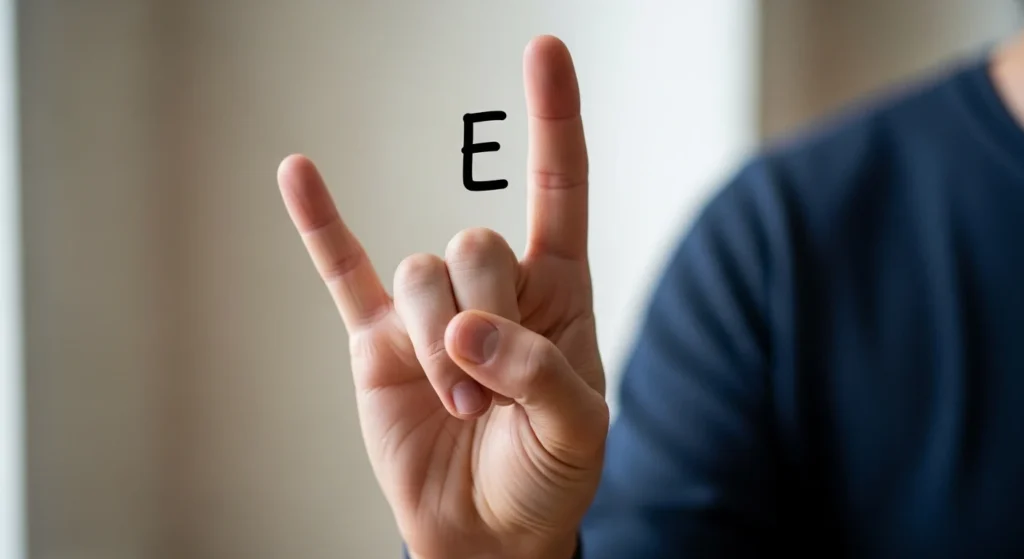
- The middle finger is part of certain handshapes representing letters. For example, it is used in forming the letter D or K, depending on finger orientation.
- Emphatic Gestures
- In informal ASL interactions, it may be used for emphasis or to imitate culturally recognized gestures. Tone, facial expressions, and body language determine meaning.
- Numbers or Symbols
- Sometimes, the middle finger’s position indicates numbers or symbolic gestures unrelated to offense.
Key point: The middle finger in sign language is functional as part of communication, and context determines if it’s offensive.
Examples of Middle Finger in Sign Language
Neutral Educational Example
A student learning ASL fingerspelling practices letters. The middle finger is extended as part of forming the letter D.
Tone: Neutral, instructional.
Casual Expressive Example
A signer jokingly shows the middle finger to a friend while laughing.
Tone: Playful or humorous.
Cultural Misunderstanding Example
A hearing person unfamiliar with ASL sees the middle finger extended and assumes insult.
Tone: Misinterpreted; requires context to clarify meaning.
Labeled Example Table of Middle Finger Usage in ASL
| Context | Middle Finger Use | Tone / Meaning |
|---|---|---|
| Alphabet Practice | Part of letters like D or K | Neutral / Educational |
| Number or Symbol | Representing numeric gestures | Neutral / Informative |
| Casual Gesture | Express frustration or humor | Playful / Emphatic |
| Cultural Gesture | Imitates common offensive gesture | Potentially offensive outside ASL |
Comparison With Related Gestures
| Gesture | Meaning in ASL | Cultural Note |
|---|---|---|
| Middle Finger Alone | Context dependent: letter or gesture | Often offensive outside ASL |
| Pointing Finger | Directing attention or indicating | Neutral |
| Thumbs Up | Approval or agreement | Universal, generally positive |
| Peace Sign | Number or symbolic gesture | Positive or neutral |
This comparison shows how context, handshape, and facial expression are essential in ASL.
Alternate Meanings
The middle finger may carry other meanings depending on:
- Different Sign Languages: British Sign Language (BSL) and others may use handshapes differently.
- Digital Communication: Emoji representations sometimes include the middle finger.
- Informal Expression: Among friends, it may convey humor, frustration, or emphasis.
Professional or Polite Alternatives
In formal ASL or professional contexts, it is best to avoid gestures that mimic offensive meanings. Alternatives include:
- Using words or letters to express frustration verbally.
- Substituting facial expressions or body language for emphasis.
- Replacing culturally sensitive gestures with neutral handshapes.
FAQs
What does the middle finger mean in ASL?
In ASL, the middle finger can be part of letters or signs and is not inherently offensive; meaning depends on context.
Is showing the middle finger always rude in sign language?
No, it is only offensive when used intentionally to insult; in letters, numbers, or neutral gestures, it is harmless.
Which letters use the middle finger in ASL?
Letters such as D or K may use the middle finger as part of the handshape for fingerspelling.
Can the middle finger convey emotion in ASL?
Yes, when used with facial expressions or body language, it can express frustration, anger, or humor.
Do other sign languages use the middle finger differently?
Yes, handshapes vary across languages like BSL, LSQ, or Auslan, and meanings depend on each language’s conventions.
Is it okay to use the middle finger jokingly in ASL?
Among friends familiar with cultural cues, it may be humorous, but context and consent are important.
Does the middle finger have digital representations?
Yes, emoji and GIFs often depict it, but interpretation depends on platform and culture.
Should beginners in ASL avoid the middle finger?
Yes, until they understand context, facial cues, and cultural implications, it’s best to avoid using it casually.
Conclusion
In sign language, the middle finger does not always carry the offensive meaning it has in everyday culture. Its meaning depends entirely on context, handshape, and accompanying facial expressions.
In ASL, the middle finger may simply be part of a letter, a number, or a symbolic gesture. When used in casual interactions, it may convey humor, frustration, or emphasis, but it should be used with caution in formal or professional settings.
Understanding the middle finger in sign language highlights the importance of context, cultural awareness, and proper communication in the deaf and community.
See Also More :
- What Does CI Mean in Police Terms Definition and Explanation for 2026
- What Does Prosper Mean in the Bible Definition and Explanation